Ceramic coating has a marketing problem: it gets sold as magic, and when it turns out to be chemistry instead, people feel burned. So here is the unmagical version, priced for the Charleston market, so you can do the math on your own cart.
What a ceramic coating actually is
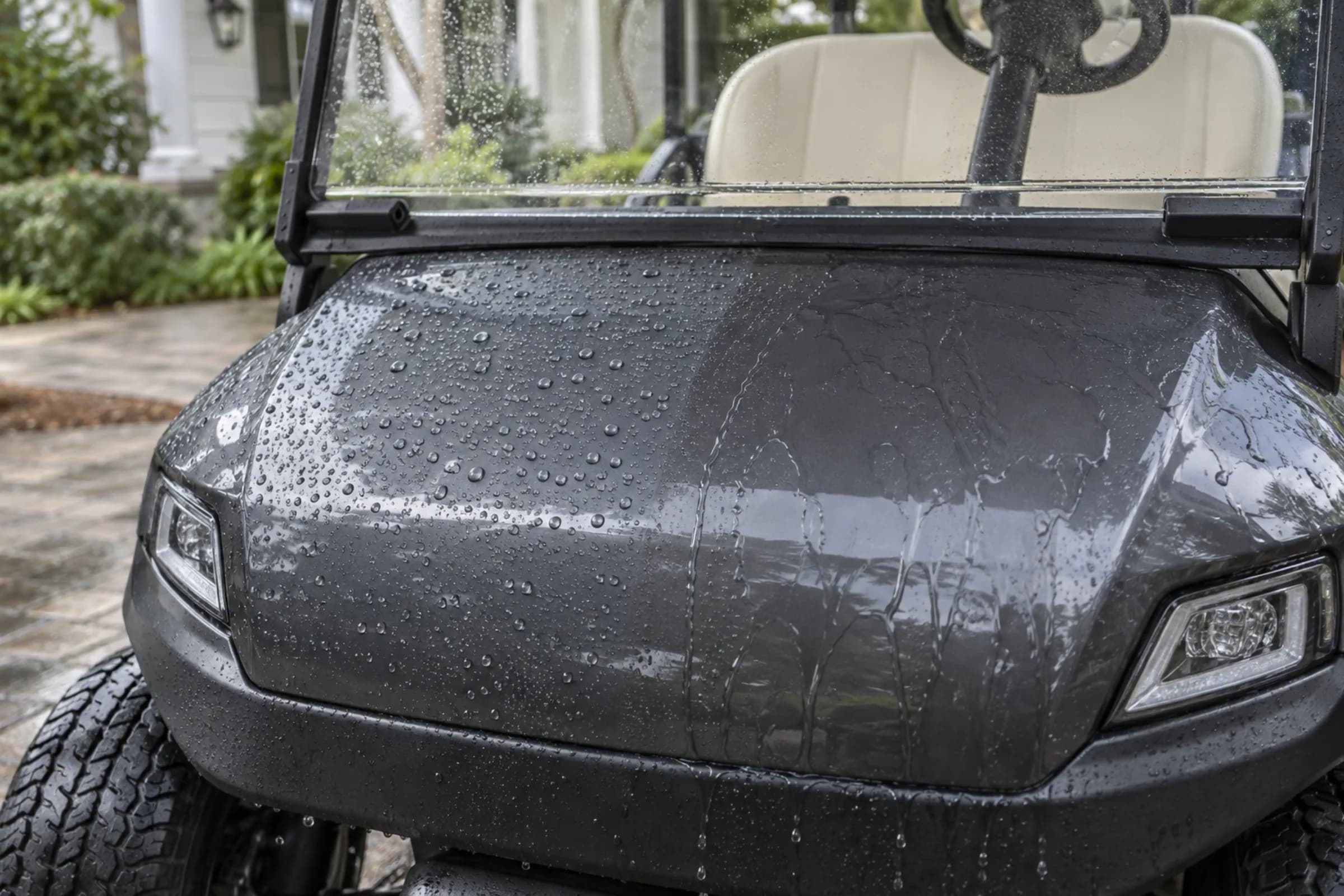
A ceramic coating is a liquid polymer, usually silicon dioxide based, that bonds chemically with paint and cures into a hard, semi-permanent layer. Once cured it is not a wax sitting on the surface; it is effectively a new top surface. Water beads and sheets off it, salt and grime bond to it weakly instead of bonding to your paint, and UV hits it first.
Professional coatings differ from the $25 spray bottles at the parts store in concentration, hardness, and prep requirements. The spray products last weeks to months. A properly applied professional coating on a golf cart lasts about two years outdoors on the coast, longer garaged.
What it does for a coastal cart
Three things, concretely:
- It stops oxidation at the paint. UV and salt work on the coating instead. On an uncoated cart parked outside near the water, visible chalking typically starts within one to three seasons. Coated, the paint underneath simply is not in the fight.
- It makes washing nearly effortless. Salt film, sunscreen handprints, and pluff mud release with a garden hose instead of a scrub. Owners consistently report this, not the gloss, as the thing they would pay for again.
- It keeps the gloss you paid to restore. Coating is applied over freshly corrected paint. The correction is what makes the cart look new; the coating is what keeps it from un-looking it.
What it does not do
It is not armor. A coating is measured in microns; it does not stop rock chips, scratches from a dragged cooler, or a dock post. It does not cover seats, and it does not bond usefully to flexible vinyl, so it does nothing for your mildew situation. And it does not eliminate washing, it just demotes washing from a chore to a rinse.
Anyone who tells you a coated cart never needs cleaning again is selling something other than chemistry.
The Charleston math
Numbers from our own menu, so you can check the logic:
- Oxidation removal with correction, when chalking arrives: $349 per occurrence, inside The Full Restore.
- On an uncoated outdoor cart near salt water, expect to want that correction roughly every one to two years to keep the finish sharp.
- A professional coating, including all of that same correction as prep: from $599, lasting about two years, details on the ceramic coating page.
So over a two-year window, an uncoated outdoor cart that gets one restore ($349) plus the extra labor of fighting salt at every wash lands within sight of the coating price, and a cart that would have needed two restores blows past it. The coating also front-loads the correction, so you get the best-looking version of your cart for the whole window instead of a sawtooth of fade-and-fix.
The three questions that decide it
Where does the cart sleep? Outside or under an open beach house within a mile of salt water: coating is the strong yes. This is Isle of Palms, Sullivan's, Folly, and the front half of the marsh islands. In a closed garage in Carolina Park: sealant twice a year probably serves you fine at a fraction of the cost.
How long are you keeping it? The coating pays over years. Selling this season? Skip it; put $349 into a pre-sale detail instead, which buyers can see, and keep the difference.
Do you actually like washing the cart? Some people find the Saturday wash meditative and do it weekly, which honestly substitutes for a lot of what coating provides. If the cart gets washed only when someone nags, the coating is cheaper than the neglect.
The bottom line
On the Charleston coast, ceramic coating is worth it for exactly the cart most people here own: parked outdoors, near salt water, kept for years. It is not worth it for garage queens, short-term carts, or as a substitute for ever rinsing anything. Decide which cart you have, and the answer falls out on its own.
Written by the crew at Clean Carts, mobile golf cart detailing for the Charleston coast. Salt questions welcome: (843) 555-0147.