Stand at Breach Inlet on a windy afternoon and you can feel the answer to this article on your skin. That fine mist is seawater going airborne, and it travels. Studies of coastal corrosion find meaningful salt deposition a mile or more inland, which is why this is not just a beachfront problem. If your cart lives anywhere from Sullivan's Island to the salty end of Mount Pleasant, it is in the deposition zone.
Here is what that salt actually does to a golf cart, ranked roughly by how fast you will see it.
Chrome and bare metal go first
Salt is an electrolyte, and corrosion is an electrical process. Deposit salt on chrome wheels, fastener heads, seat hinges, and battery terminals, add Charleston humidity, and you have built a slow battery that eats metal. Chrome pitting shows up in as little as one hard season on an oceanfront cart. Battery terminals grow the familiar green-white crust that eventually becomes an electrical problem, not a cosmetic one.
What stops it: removal and barrier, in that order. Salt that is rinsed off cannot conduct. Terminals cleaned and coated with a dielectric treatment stop the reaction at the source. This is the cheapest prevention on the whole cart, which makes it the strangest thing to skip.
Paint oxidizes into chalk
Paint does not rust, but it breaks down in its own way. UV starts the damage by breaking the resin binders in the top layer of paint. Salt accelerates it because the deposited layer is hygroscopic, meaning it pulls moisture out of the air and holds a damp, reactive film against the surface around the clock, even on a cart parked in the shade.
The visible sequence: gloss dulls, then color flattens, then the surface turns chalky enough that a finger swipe comes back dusty with pigment. At that point washing changes nothing, because the damaged layer is the paint itself. The fix is mechanical polishing to cut the dead layer off, which is a restoration job, not a wash.
What stops it: keeping the salt film off with regular washing, and putting a sacrificial layer between paint and weather. A synthetic sealant buys about six months. A professional ceramic coating buys about two years. Bare, unwashed paint near the ocean buys you an oxidation removal appointment.
Vinyl seats grow things
Seats suffer from a partnership: UV cooks the plasticizers out of vinyl, making it stiff and crack-prone, while humidity and organic grime feed mildew in the stitching. Salt joins in by holding moisture against the seams. The mildew you can see as spots along the piping is the surface of a colony rooted in the stitch holes, which is why wiping it off works for about two weeks.
What stops it: extraction cleaning that removes the growth rather than smearing it, a water-based UV protectant that keeps the vinyl flexible, and airflow. A sealed waterproof cover over a damp cart is a mildew greenhouse; if you cover, use a breathable cover over a dry cart.
The frame corrodes where you never look
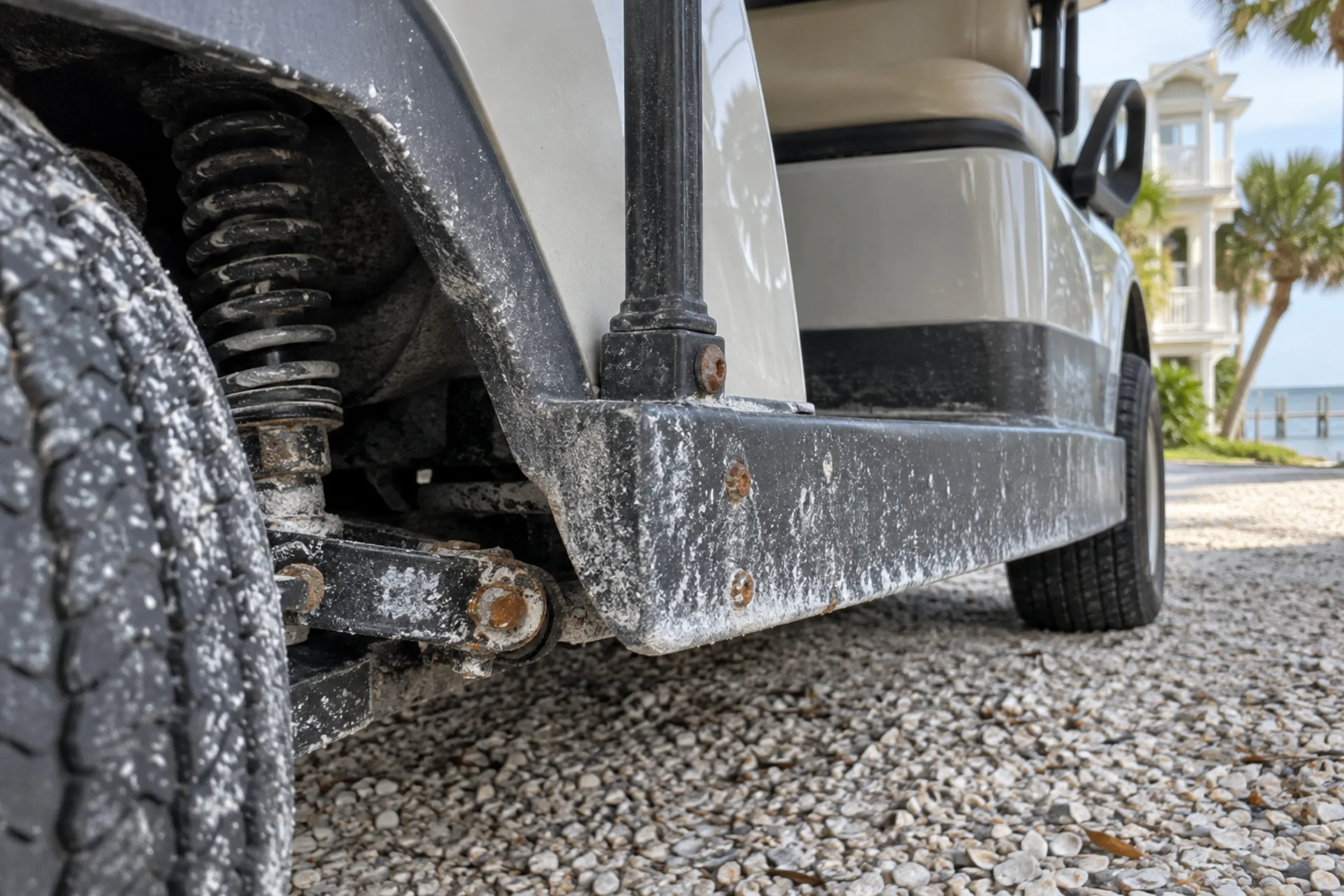
The most expensive salt damage happens underneath. Frame rails, suspension points, and the underside hardware collect road spray and beach sand, and nobody hoses off the bottom of a golf cart on a Saturday morning. On steel-framed carts, this is where structural rust begins. On aluminum frames it shows up as white powdery oxidation at joints and fasteners.
What stops it: an undercarriage rinse as a routine part of service, not a special request. It takes minutes and reaches exactly the places a driveway wash never does.
The realistic protection plan
Nobody needs to treat a golf cart like a museum piece. A coastal cart needs three habits:
- A freshwater rinse after exposure. After a windy beach day or a causeway run, two minutes with a hose removes most of the day's deposit. This one habit, done consistently, outperforms any product.
- Scheduled real washes. A monthly hand wash with a pH-neutral soap removes the bonded film a rinse leaves behind, and gets the seams, flares, and hardware. This is exactly what our exterior detail is, and why it runs on a monthly plan.
- A barrier on the paint. Sealant twice a year at minimum. For carts parked outside near open water, ceramic coating is the honest recommendation, and we wrote a whole article on whether it pays for itself.
Salt is not dramatic. It never does anything to your cart today. That is the trap, and also the good news: a boring, consistent routine beats it completely, and the cart you protect this season is the cart that still looks bought-last-year when your neighbor's has gone chalky.
Written by the crew at Clean Carts, mobile golf cart detailing for the Charleston coast. Salt questions welcome: (843) 555-0147.